
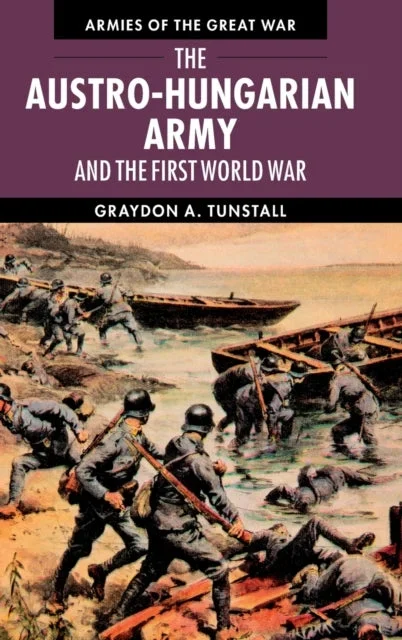
Description
The Austro-Hungarian Royal and Imperial Army was grossly under-strength and inadequately trained for modern warfare, facing a two-front offensive against Russia and Serbia and suffering from poor strategic direction and outdated tactics. It collapsed in 1918.
Format: Hardback
Length: 410 pages
Publication date: 30 September 2021
Publisher: Cambridge University Press
The Austro-Hungarian Royal and Imperial Army played a significant role in the First World War, but it entered the conflict with significant weaknesses. Graydon A. Tunstall’s book provides a comprehensive account of the army’s preparation, deployment, and performance during the war.
When the war began, the Habsburg Army faced significant challenges. It was undertrained and undermanned, with outdated weapons and equipment, and most of its troops were inadequately prepared for modern warfare. The army mobilized over one million troops, creating an enormous logistical challenge of forging an army from the diverse cultures, languages, economic, and educational backgrounds of the Empire’s peoples.
The army suffered from poor strategic direction and outdated tactics. It faced a two-front offensive against both Russia and Serbia, which further exacerbated its weaknesses. The army’s performance on the battlefields of Galicia, Serbia, Romania, the Middle East, and Italy is examined in detail by Tunstall. He charts the army’s decline from its initial successes to its ultimate collapse in 1918.
The book provides a valuable insight into the Austro-Hungarian Royal and Imperial Army’s experiences during the First World War. It highlights the army’s weaknesses, its struggles to adapt to the changing nature of warfare, and its ultimate collapse. Tunstall’s work is a must-read for anyone interested in the history of the war and the role of the Austro-Hungarian Army in it.
Weight: 860g
Dimension: 158 x 237 x 36 (mm)
ISBN-13: 9780521199346


Reviews
There are no reviews yet.