
Description
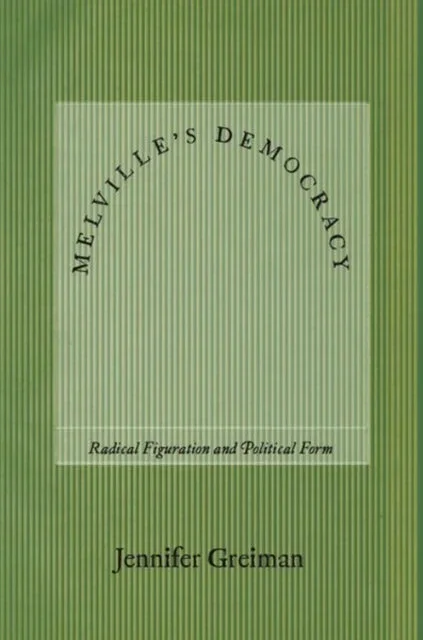
Herman Melville’s political thought explored the instability of democracy, offering a radical reimagining of democratic foundations, relations, and ways of being. Jennifer Greiman argues that Melville’s densely figurative aesthetics give form to this project, modeling how we can think democracy in political theory today. Her book explores Melville’s readings in political philosophy and aesthetics, showing how he engaged with key problems in political theory to produce a body of radical democratic art and thought.
Format: Hardback
Length: 350 pages
Publication date: 31 January 2023
Publisher: Stanford University Press
Herman Melville’s work explores the instability of democracy and its creative potential. Jennifer Greiman argues that Melville’s figurative aesthetics shape a radical reimagining of democratic foundations, relations, and ways of being, offering a model for contemporary democratic theory. Across Melville’s five decades of writing, Greiman identifies a literary formalism that is deeply political and advances the project of democratic theory. He explores Melville’s readings in political philosophy and aesthetics, revealing how he engaged with key problems in political theory, such as the paradox of foundations, the vicious circles of sovereign power, and the fragility of the people. Melville’s experimental aesthetics yield scenes of green and growing life, circular structures, and images of a groundless world, which serve as forms for understanding democracy as a collective project in flux. Greiman finds a significant precursor to the tradition of radical democratic theory in the US and France that emphasizes transience and creativity over the foundations and forms prized by liberalism. Such politics are necessarily aesthetic, attuned to material and sensible distinctions, and open to new forces of creativity.
Weight: 690g
Dimension: 159 x 237 x 29 (mm)
ISBN-13: 9781503633322



Reviews
There are no reviews yet.