
Description
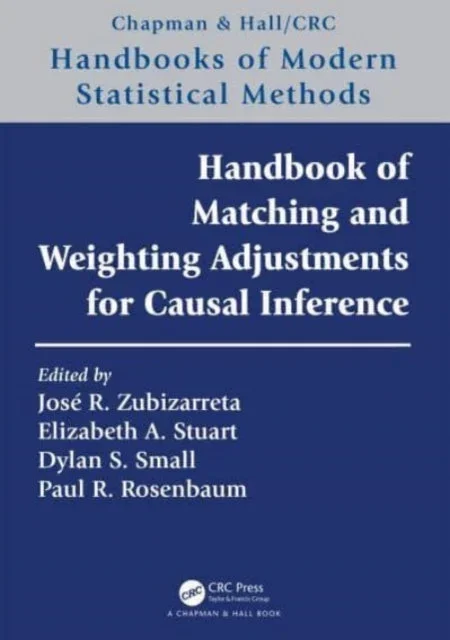
Observational studies infer the effects of treatments, policies, programs, interventions, or exposures in unethical or impractical contexts. This handbook provides a comprehensive survey of recent methods of adjustment, including matching, weighting, machine learning, and their combinations. It is for researchers in medicine, economics, public health, psychology, epidemiology, public program evaluation, and statistics.
Format: Hardback
Length: 622 pages
Publication date: 11 April 2023
Publisher: Taylor & Francis Ltd
Observational studies are conducted when randomized experimentation is unethical or impractical, allowing researchers to infer the effects of treatments, policies, programs, interventions, or exposures in a specific context. One crucial aspect of observational studies is adjusting for visible pretreatment differences between the treated and control groups. This adjustment is necessary to ensure that the observed effects are not solely due to these differences. Two modern forms of adjustment are multivariate matching and weighting.
Multivariate matching involves using statistical techniques to match individuals in the treated and control groups based on various characteristics, such as age, gender, and disease severity. This helps to reduce the bias introduced by differences in these characteristics between the groups. Weighting is another method used to adjust for pretreatment differences. It involves assigning a weight to each individual in the treated group based on their probability of being in the control group. This weight is then used to adjust the observed effects in the treated group to account for the differences in the composition of the two groups.
This handbook provides a comprehensive survey of the most recent methods of adjustment by matching, weighting, machine learning, and their combinations. It covers various topics, including the theoretical foundations of matching and weighting, practical considerations, and applications in different fields. Three additional chapters introduce the steps from association to causation that follow after adjustments are complete.
Matching and weighting are not used alone but are part of the design of an observational study. When used in conjunction with models for the outcome, matching and weighting can enhance the robustness of model-based adjustments. The book is intended for researchers in medicine, economics, public health, psychology, epidemiology, public program evaluation, and statistics who examine evidence of the effects on human beings of treatments, policies, or exposures.
By employing these adjustment methods, observational studies can provide valuable insights into the effects of interventions and exposures, even when randomized experimentation is not feasible. It is important for researchers to carefully consider the appropriate adjustment techniques and to apply them to their study designs to ensure the validity and reliability of their findings.
Weight: 1330g
Dimension: 254 x 178 (mm)
ISBN-13: 9780367609528




Reviews
There are no reviews yet.